
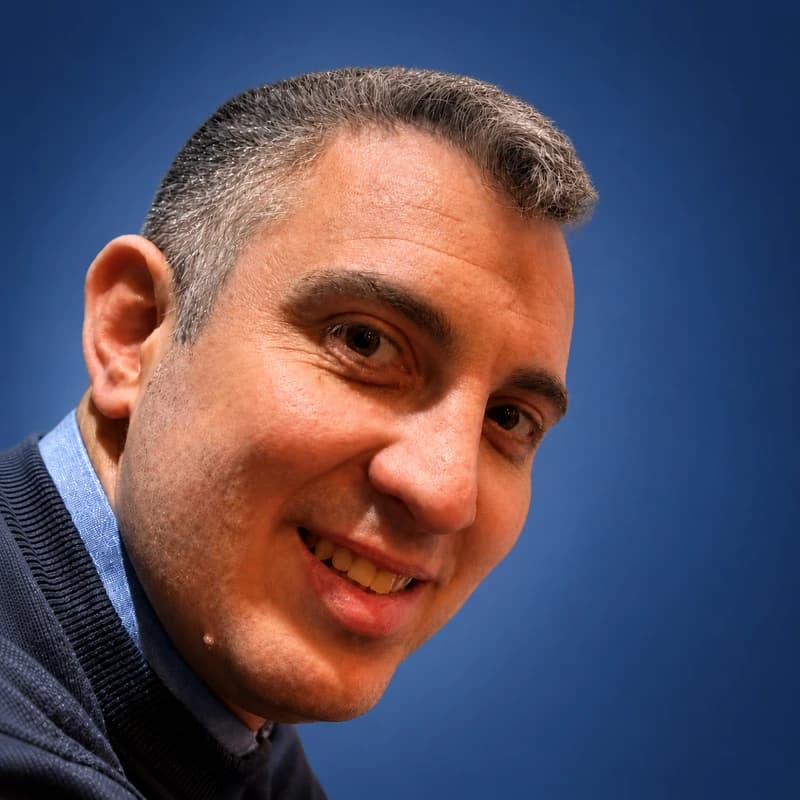
I founded companies and wrote the software that ran them. That's why I do this job.
I'm Marco Salatin. I understand the business problem, choose the architecture, build it and ship it. Ten years of software, two startups founded, 8+ products live.
Developer and founder: the sum is what makes a CTO.
The CTO role gets described as a management job. In my experience it's a translation job: taking a commercial goal and turning it into a system that works, with the money and the time you actually have.
That translation needs two trades at once. You have to understand why the company wants the thing — what happens if it lands late, what can be cut, where the money is. And you have to be able to build it, because an architectural decision you can't implement isn't a decision: it's an opinion.
I've done both sides, not in theory. I founded two companies and wrote their software: the same person who decided what to build then built it, and paid for it the following month. That's where my way of working for you comes from: understand the business, build it, solve it.
If you care about how I think about it — why technical complexity should be kept under control rather than shown off — I wrote it down here: Blue Silk. That's the philosophy behind how I work, and the full CV if you prefer the facts in chronological order.
Three times from idea to product, as a founder.
I didn't learn risk by reading about it. I learned it building my own products, with my own money and my own deadlines.
Lumi Industries
Co-founder & software lead
Roncade · H-Farm
Resin DLP 3D printing. I built the entire stack, from the controller firmware to the slicing software. That's where I learned the part you can't study: customer development, integrated hardware-software delivery, and what it means to sell a product you also have to maintain.
Alma Robotics
Founder & CTO
Vittorio Veneto, Italy
Service robotics. I founded the company and built the platform's whole software stack: embedded firmware, cloud backend, web frontend. End-to-end ownership of technical decisions, architecture and product direction — with real money running out, not a simulation.
LifeVault
Founder & CTO
Personal product · in production
A web app for a family's admin life: documents, deadlines and household finances (budget, actual spending, transactions, Excel export). Zero-knowledge: client-side encryption with non-extractable CryptoKeys and vault key rotation. Sharing with family members and children, six languages, AWS infrastructure as code. In production and under continuous development since February 2026: I keep building, even when nobody is paying me to.
What I can do with my hands, not just in conversation.
Architecture that holds
I pick the structure based on how long it has to last and who maintains it after me. Microservices where they earn their keep, a monolith where that's the honest answer: complexity is a bill you pay every month, not once.
Code, not slides
Python/FastAPI, TypeScript/Next.js, Java, AWS. I don't delegate the delicate parts: integrations, authentication, payments, performance under load. Those are the ones that decide whether a project survives.
Legacy systems
I migrated a legacy invoicing system with 1,000+ users to microservices without stopping operations. The real work isn't writing the new thing: it's switching off the old one without hurting anybody.
Data at scale
I designed a data enrichment pipeline that processed 6 million Italian companies. Once the numbers grow, architectural mistakes stop being theoretical.
Teams
I led 7 developers on a product in the public tenders space. I can tell a slow team from a team that was briefed badly — and in the second case, the team isn't the problem.
AI as leverage, not as a slogan
I use AI agents to genuinely speed up development on real codebases. Not to run demos: to shorten the distance between a decision and working software.
What actually changes for you.
You can ask me a business question and get a technical answer, or the other way round, without going through a translator who drops things along the way.
When I tell you something takes three weeks, that number comes from someone who has worked those three weeks — not from an estimate inherited from the team and passed along untouched.
If your current supplier is telling you something that doesn't add up, I notice — and I tell you before you sign the second year of the contract.
And my stated goal is to make myself unnecessary: I leave process, documentation and a team that can carry on without me. If you still need me afterwards, I did the job badly.
What I'm not.
I'm not a manager who stopped writing code
People who haven't touched code in years judge by hearsay: they underestimate costs, overtrust estimates, and don't notice when a quote doesn't add up. My hands are still in it.
I'm not a developer who never had a budget to balance
I've founded companies: I know what happens when the elegant technical choice burns the months you had left. I optimise for the company's outcome, not for the engineer's satisfaction.
I'm not an agency
I won't hand you to a junior after you sign. I take on few projects at a time and I run them myself, start to finish. If you need twenty people quickly, I'm the wrong call.
What people ask me before we start.
Why pick you over hiring a CTO?
Because in most cases you don't need a full-time CTO: you need the right decisions over the next few months. A senior CTO in Italy costs €90-140k plus equity and takes months to find. I start within days, at the fraction of time you actually need, and I stay until the structure stands on its own.
Do you still write code, or only strategy?
Both, and that's the point. I take on the parts where a mistake is expensive and leave the rest to the team. If I can't implement an architectural decision myself, to me it isn't a decision yet: it's an opinion.
What did founding companies teach you?
Respect for money and time. When you're the one funding development, you stop falling in love with solutions and start asking what happens if this isn't working by March. That's the question I bring into client projects.
Do you also work purely as a senior developer, without the CTO role?
Yes. Sometimes you need a technical lead who decides, sometimes you just need someone to build the hard parts properly. They're two ways into the same problem: see fractional CTO and senior development.
Where do you work from?
From Conegliano, in the province of Treviso, Italy. On-site across the Italian Northeast — Treviso, Conegliano, Vittorio Veneto, Padua, Venice, Belluno, Pordenone — and remotely across Italy and Europe. Serious work happens both ways, as long as it's clear when being there in person actually matters.
Need a technical lead who also builds?
Book 30 free minutes. Tell me where you're stuck and I'll tell you whether I can help — and if I can't, I'll say so straight away.
30 minutes · No commitment · Reply within 24 hours